
High Density Trash Bags

Filters Clear All
Brands
Price
Application
Bottom Seal
Capacity Range (Volume) [Max]
Closure
Color Family
Color(s)
Flat Pack/Roll
Grade
Height
Material(s)
Maximum Volume Range
Scent Indicator
Thickness
Waste Bag Closure Type
Width






1-2 Day Delivery
$48.56 $94.14
Case of 250($0.19/Each)
Choose Your Frequency:
Volume Pricing
1-2 Day Delivery
$37.87 $85.78
Box of 250($0.15/Each)
Choose Your Frequency:
Volume Pricing
1-2 Day Delivery
$31.63 $60.99
Case of 500($0.06/Each)
Choose Your Frequency:
Volume Pricing
1-2 Day Delivery
$44.94 $84.07
Box of 100($0.45/Each)
Choose Your Frequency:
Volume Pricing
1-2 Day Delivery
$64.14 $128.75
Case of 1000($0.06/Each)
Choose Your Frequency:
Volume Pricing
1-2 Day Delivery
$53.00 $63.59
Box of 500($0.11/Each)
Choose Your Frequency:
Volume Pricing
1-2 Day Delivery
$54.46 $118.96
Box of 500($0.11/Each)
Choose Your Frequency:
Volume Pricing
1-2 Day Delivery
$42.23 $81.81
Box of 250($0.17/Each)
Choose Your Frequency:
Volume Pricing
1-2 Day Delivery
$52.60 $115.84
Box of 250($0.21/Each)
Choose Your Frequency:
Volume Pricing
1-2 Day Delivery
$22.64 $44.51
Case of 500($0.05/Each)
Choose Your Frequency:
Volume Pricing
1-2 Day Delivery
$63.06 $113.34
Case of 1000($0.06/Each)
Choose Your Frequency:
Volume Pricing
1-2 Day Delivery
$90.90 $153.02
Case of 1000($0.09/Each)
Choose Your Frequency:
Volume Pricing
1-2 Day Delivery
$19.61 $26.71
Case of 200($0.10/Each)
Choose Your Frequency:
Volume Pricing
1-2 Day Delivery
$75.02 $140.19
Case of 500($0.15/Each)
Choose Your Frequency:
Volume Pricing
1-2 Day Delivery
$19.09 $28.63
Case of 100($0.19/Each)
Choose Your Frequency:
Volume Pricing
1-2 Day Delivery
$69.88 $138.71
Case of 250($0.28/Each)
Choose Your Frequency:
Volume Pricing
1-2 Day Delivery
$79.28 $115.94
Case of 200($0.40/Each)
Choose Your Frequency:
Volume Pricing
1-2 Day Delivery
$72.58 $163.77
Case of 200($0.36/Each)
Choose Your Frequency:
Volume Pricing
1-2 Day Delivery
$37.01 $60.95
Case of 250($0.15/Each)
Choose Your Frequency:
Volume Pricing
1-2 Day Delivery
$140.36 This item is listed at the minimum advertised price.
Case of 200
Choose Your Frequency:
Volume Pricing
1-2 Day Delivery
$44.87 $98.31
Case of 150($0.30/Each)
Choose Your Frequency:
Volume Pricing
1-2 Day Delivery
$43.24 $104.79
Case of 1000($0.04/Each)
Choose Your Frequency:
Volume Pricing
1-2 Day Delivery
$37.80 $82.11
Case of 250($0.15/Each)
Choose Your Frequency:
Volume Pricing
1-2 Day Delivery
$29.58 $62.65
Case of 2000($0.01/Each)
Choose Your Frequency:
Volume Pricing
1-2 Day Delivery
$58.36 $114.49
Case of 250($0.23/Each)
Choose Your Frequency:
Volume Pricing
1-2 Day Delivery
$39.01 $94.05
Case of 150($0.26/Each)
Choose Your Frequency:
Volume Pricing
1-2 Day Delivery
$52.40 $104.69
Case of 150($0.35/Each)
Choose Your Frequency:
Volume Pricing
1-2 Day Delivery
$58.36 $113.37
Case of 150($0.39/Each)
Choose Your Frequency:
Volume Pricing
1-2 Day Delivery
$29.81 $47.50
Case of 1000($0.03/Each)
Choose Your Frequency:
Volume Pricing
1-2 Day Delivery
$44.05 $65.28
Case of 500($0.09/Each)
Choose Your Frequency:
Volume Pricing
1-2 Day Delivery
$42.92 $65.28
Case of 1000($0.04/Each)
Choose Your Frequency:
Volume Pricing
1-2 Day Delivery
$50.96 $86.88
Case of 1000($0.05/Each)
Choose Your Frequency:
Volume Pricing
1-2 Day Delivery
$48.83 $73.92
Case of 500($0.10/Each)
Choose Your Frequency:
Volume Pricing
1-2 Day Delivery
$36.14 $58.95
Case of 500($0.07/Each)
Choose Your Frequency:
Volume Pricing
1-2 Day Delivery
$47.76 $70.43
Case of 250($0.19/Each)
Choose Your Frequency:
Volume Pricing
1-2 Day Delivery
$36.61 $50.40
Case of 2000($0.02/Each)
Choose Your Frequency:
Volume Pricing
High density trash bags built for everyday commercial waste
High density trash bags (HDPE) are a go-to choice for high-volume, lightweight waste streams where you want dependable performance without paying for unnecessary thickness. They are commonly used in offices, schools, healthcare support areas, restaurants (front-of-house and prep areas), and janitorial programs that need consistent liners, predictable case counts, and quick replenishment.
HDPE liners are known for puncture resistance and a crisp, lightweight feel. They are typically less stretchy than low density liners, so selecting the right size and gauge matters. With 100+ SKUs, bulk case options, and 1-2 day shipping, its easy to standardize your liner program and reduce emergency runs.
How to choose the right HDPE trash bag
Bag size: match the can, not the label
Start with the container dimensions. A bag that is too small slips and tears; too large wastes material and increases cost per changeout. As a rule, choose a width that fits the can circumference and a length that covers the can height plus extra for a secure overhang and tying. If you are unsure, measure the can opening and height and match to the closest liner size.
Gauge and strength: what HDPE does best
HDPE is efficient for paper, packaging, restroom waste, and other light-to-medium loads. It resists punctures from sharp corners and dry debris, but it does not stretch like LLDPE. If your waste is heavy, wet, or irregular (glass, metal edges, food liquids), you may need a different resin type or a thicker gauge.
Star seal vs flat seal bottoms
Many commercial HDPE liners use a star seal bottom to help distribute weight and reduce leaks at the seam. Flat seal bags can be cost-effective for certain applications, but star seal is often preferred for general janitorial use where leak control matters.
Coreless rolls, interleaved packs, and case counts
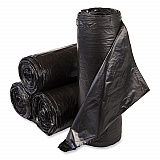
HDPE trash bags are frequently sold on rolls for fast dispensing and storage efficiency. Coreless rolls reduce waste and fit many dispensers. Interleaved packs can speed up changeouts in high-traffic restrooms and breakrooms. For procurement teams, consistent case pack and pallet quantities help control spend and simplify reordering.
Where high density liners fit best (and where they do not)
Best-fit use cases
- Office and classroom trash: paper, wrappers, light packaging
- Restroom waste: consistent changeouts, clean handling
- Healthcare support areas: non-sharps, non-regulated waste streams
- Retail backrooms: light corrugate scraps and packaging
When to consider an alternative
If you need more stretch for heavy or wet loads, consider Low Density Trash Bags for thicker, more elastic performance. If you want faster closure and cleaner handling for staff, Drawstring Trash Bags can reduce spills during transport. If sustainability requirements are driving your spec, Repro Trash Bags may be a better fit for recycled-content purchasing policies.
Buying in bulk: reduce cost per bag and avoid stockouts
Bulk ordering is the simplest way to lower your cost per changeout and keep your team consistent across locations. Standardizing on a few sizes and gauges reduces training issues, prevents overstuffing, and makes inventory counts easier. If you manage multiple sites, case-level purchasing also helps you plan freight and minimize rush shipments.
Need help matching a liner to a can size or waste type? Knowledgeable customer support can quickly confirm dimensions, gauge, seal type, and case pack so you can buy with confidence and reorder without surprises.
Quality and compliance considerations
Consistent specs for procurement
For commercial programs, consistency matters as much as price. Look for clear specifications on size, gauge, seal type, and case quantity so you can maintain the same performance across deliveries and locations.
Application-specific requirements
Some environments require specific colors or labeling practices for sorting and waste segregation. If you have internal policies for waste streams, confirm liner color, opacity, and strength before standardizing. When in doubt, choose a spec that prevents leaks and reduces bag failures, since failures increase labor time and total cost.
Brands and assortment
Choose from trusted commercial lines including Inteplast Group, Heritage, Boardwalk, AbilityOne, Ultra Plus, Good 'n Tuff, Pitt Plastics, Accufit, Berry Plastics, and RePrime. With a wide assortment of HDPE sizes and gauges, you can align performance to each area of your facility while keeping purchasing simple.
High Density Trash Bags FAQ
Are HDPE trash bags leak resistant?
They can be leak resistant when properly sized and when using a star seal bottom, but HDPE is typically best for dry waste. For frequent liquids or heavy wet trash, consider a thicker gauge or a low density liner.
Do high density trash bags come on rolls for dispensers?
Yes. Many HDPE liners are available as coreless rolls or standard rolls for easy dispensing and faster changeouts, with case packs designed for bulk purchasing and consistent reorders.
How do I choose the right size high density trash bag for my can?
Measure the can opening and height, then select a bag width that fits the can circumference and a length that covers the height plus extra for overhang and tying. If you are between sizes, sizing up usually reduces slip-offs and tears.
What gauge should I buy for high density trash bags?
Choose gauge based on the weight and type of waste. Lighter gauges work for paper and restroom waste; higher gauges are better when punctures or heavier loads are common. If you share your can size and waste stream, support can help match the right spec.
What is the difference between high density (HDPE) and low density trash bags?
High density (HDPE) bags are lighter and more puncture-resistant for dry, lightweight waste, but they stretch less. Low density bags stretch more and are often better for heavy, wet, or irregular loads.